.png)
Why Agentic AI Will Change the Way You Close Your Books in 2026 (And Why It’s Not Enough Alone)
- Thinking Ledger
- Mar 10
- 5 min read
It’s the 5th of the month. In 2022, you’d be chasing down receipts and pestering your Ops lead about a mysterious $4,000 charge from a vendor called “CloudFlow.” In 2024, you might have had a basic automation tool that flagged the transaction but still required you to click “confirm.”
Welcome to Tuesday, March 10, 2026.
Today, you don’t "do" the month-end close. Your Agentic AI does. Or at least, it’s supposed to.
We’ve officially moved past the era of "dumb" automation into the age of autonomous agents: AI that doesn't just follow a script but makes decisions, investigates discrepancies, and talks to your other software. But as we sit here in 2026, many founders are discovering a painful truth: An autonomous engine without a skilled pilot is just a very fast way to drive your financials off a cliff.
At ThinkingLedger, we’ve seen the "Agentic Revolution" transform accounting from a reactive chore into a proactive strategy. But we’ve also seen the "hallucinations" that can tank a due diligence process. Here’s what you need to know about the 2026 accounting landscape.
What is Agentic AI (And Why Should Your Balance Sheet Care?)
In the "old days" (about 18 months ago), AI in accounting was mostly about OCR (Optical Character Recognition): reading a PDF invoice and putting the numbers into a box.
Agentic AI is different. These agents are designed to achieve a goal, not just execute a task. Instead of saying "Scan this receipt," you say "Reconcile our AWS usage against the budget and flag any 10% deviations."
The agent then:
Logs into your AWS console.
Pulls the detailed usage report.
Compares it to your QuickBooks or Xero data.
Identifies that a developer left a high-compute instance running over the weekend.
Drafts an email to the CTO and prepares the journal entry for the month-end.
The 2026 Impact by the Numbers
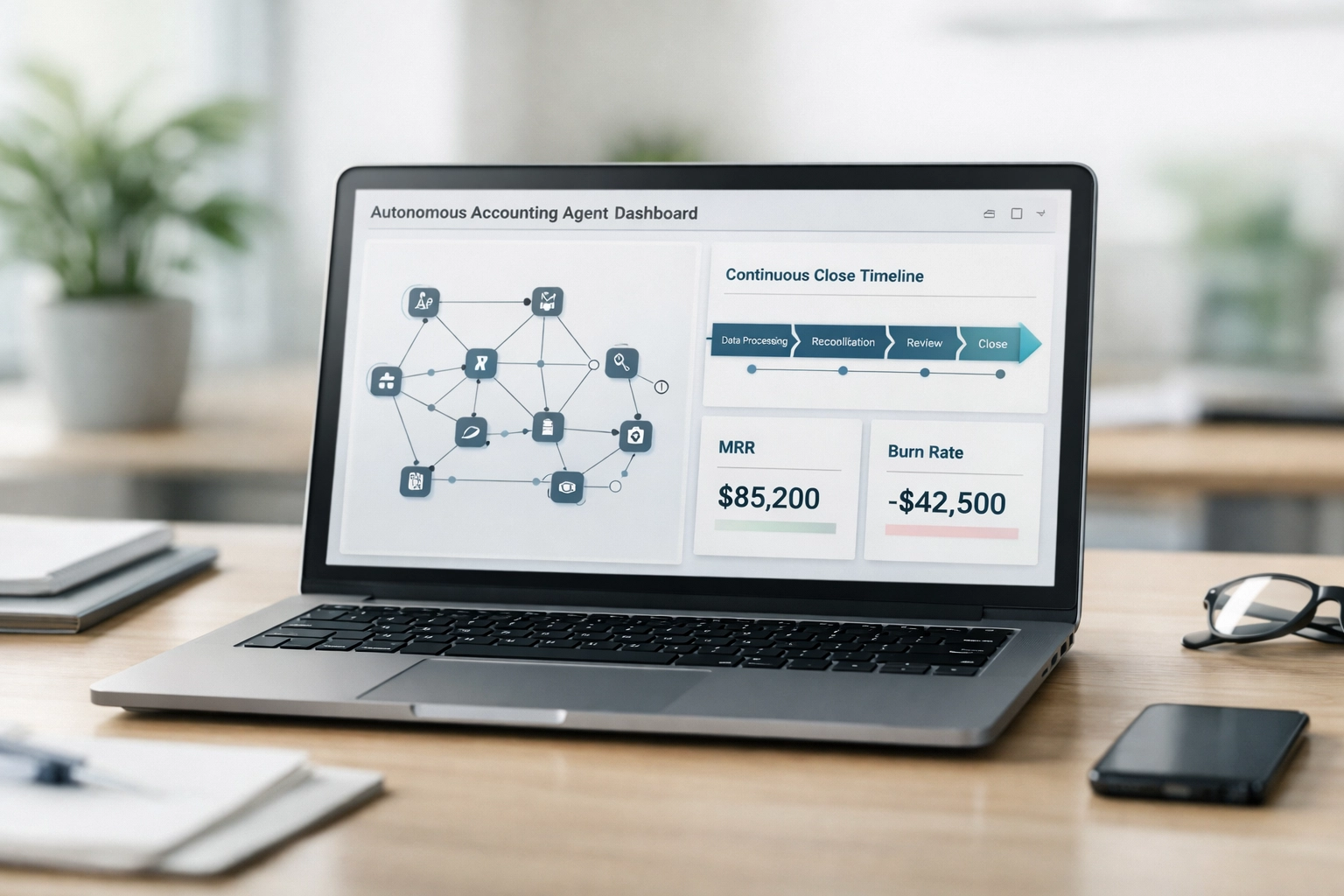
Recent industry data shows that AI-powered accounting operations are achieving a 55% faster monthly close. In fact, by the start of this year, nearly 80% of routine bookkeeping tasks: the stuff that used to keep junior accountants busy for weeks: have been fully automated.
For you, the founder, this means the "Month-End Close" is dying. We are moving toward Continuous Accounting, where your burn rate and financial health are visible in near real-time.
The Efficiency Trap: Why "Autonomous" Doesn't Mean "Correct"
It sounds like a dream, right? Fire the accountants, let the bots handle the ledger, and focus on your Product-Market Fit.
Hold that thought.
While AI agents are incredible at processing volume, they lack context. And in accounting, context is everything. An AI agent might see a $50,000 payment to a law firm and perfectly categorize it under "Legal Expenses."
But what the AI doesn't know is that those legal fees were specifically for patent filings related to a new R&D project that qualifies for a tax credit. Or perhaps those fees should be capitalized as part of an acquisition. If you rely solely on the agent, you’re missing out on massive tax savings or, worse, misrepresenting your EBITDA to potential investors.
The Rise of "AI Hallucinations" in the Ledger
In 2026, we’ve coined a new term in the office: The Phantom Entry.
This happens when an AI agent, trying to be "helpful," reconciles a transaction based on a pattern it thinks it sees, but doesn't actually exist. We’ve seen agents "invent" accruals because they expected a bill that hadn't arrived yet, leading to a balance sheet that looks healthy on paper but is a mess in reality.
Founder Tip: Never trust an autonomous reconciliation without an audit trail. If your AI can’t show its work, it’s not an asset; it’s a liability.
The ThinkingLedger Philosophy: The "Cyborg" Accountant
At ThinkingLedger, we don't fight the machines; we lead them. We believe the future of finance is a Human-in-the-Loop model.

We use cutting-edge accounting integrations like Stripe, Shopify, and Deel to feed our agents high-quality data. But the final layer: the "Sanity Check": is always performed by an expert who understands your specific industry.
Why Human Expertise is Non-Negotiable in 2026:
Strategic Alignment: An AI can tell you how much you spent on marketing. Only a Fractional CFO can tell you if that spend is scaling your LTV/CAC ratio effectively or if you’re just burning cash to stay in the same place.
Revenue Recognition: For SaaS and subscription startups, revenue recognition is a minefield. AI agents often struggle with the nuances of "performance obligations" under ASC 606. One wrong click and your revenue is overstated, which is a nightmare during a Series B due diligence.
Complex Instruments: If your startup uses SAFE notes, convertible notes, or warrants, an AI agent will likely have a breakdown trying to figure out the equity impact. These require the steady hand of a professional.
Multi-Currency Chaos: If you’re hiring globally via Deel and selling in five countries, currency revaluation (ASC 830) can distort your profit numbers. An AI might follow the math, but a human understands the economic impact of those swings.
2026 Diagnostic: Is Your AI Closing Your Books or Just Making a Mess?
Use this quick grid to see where your current accounting process stands.
Feature | The "Bot-Only" Approach | The ThinkingLedger Approach |
Speed | 10/10 (Instant processing) | 9/10 (Fast AI + Human verification) |
Accuracy | 85% (Prone to "pattern hallucinations") | 99.9% (Triple-checked for context) |
Strategic Advice | None (Just data) | High (Fractional CFO insights) |
Audit Readiness | Risky (Difficult to explain "why") | Guaranteed (Clean docs and trails) |
Investor Confidence | Low (Needs manual re-work) | High (Ready for due diligence) |

How to Prepare Your Startup for the Agentic Era
If you want to leverage Agentic AI without the side effects, you need to build a solid foundation. Here is your 2026 AI-Accounting Checklist:
Standardize Your COA: Your Chart of Accounts needs to be clean. If you have five different categories for "Software," your AI will get confused. Clean it up now with a proper expense classification guide.
Fix Your Data Inputs: An AI agent is only as good as the data it sees. Ensure your integrations (Stripe, Deel, Mercury) are direct and not filtered through manual spreadsheets.
Choose the Right Method: Are you still on Cash basis because it’s "easier"? For a growing startup in 2026, Accrual is the only way to give an AI the "rules" it needs to be useful.
Hire for Oversight, Not Entry: Stop looking for "Bookkeepers" who just enter data. Look for partners who know how to manage AI agents and provide virtual consultations that focus on strategy.
The Verdict: The "Finance Partner" is the New Solution to the "Founder Blind Spot"
The money’s gone, the momentum fades, and founders are left wondering where the runway went. This is the classic story of the "automated" startup that didn't have a human watching the gauges.
Agentic AI is a tool, not a replacement for financial intelligence. It allows us at ThinkingLedger to stop being "historians" who tell you what happened last month, and start being "navigators" who tell you what’s going to happen next quarter.
By automating the "what," we can spend our time with you on the "so what?"
So what if our burn rate is $100k? Can we afford that next hire?
So what if our inventory method is FIFO vs. Weighted Average? How does it impact our taxes?
Don't let your books be a black box of "autonomous" entries. Transition to a model where technology does the heavy lifting and experts provide the heavy thinking.

Ready to see what a "Cyborg" accounting team can do for your runway?
Whether you’re a returning client or a founder looking to prepare for tax season with zero stress, we’re here to bridge the gap between AI efficiency and human strategy.
Let's build a defensible, investor-ready financial engine together. 🚀
Comments